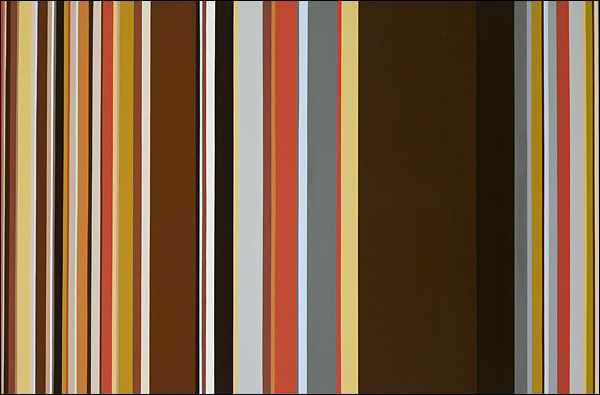
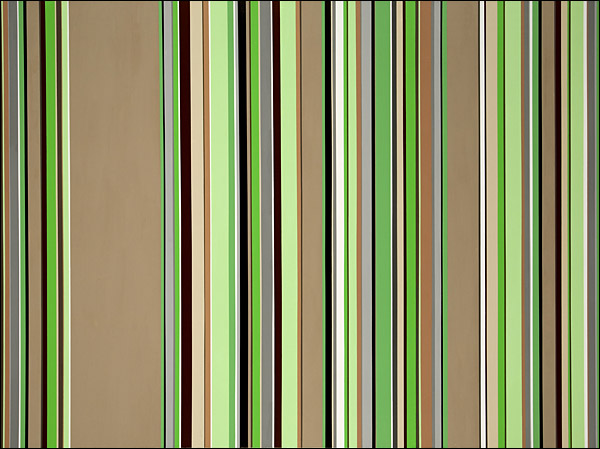
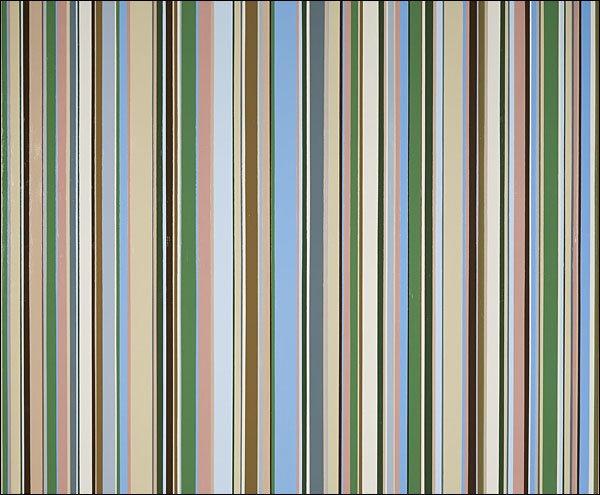
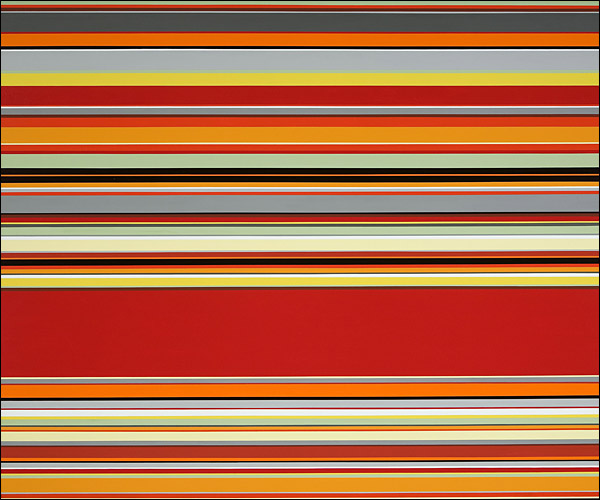
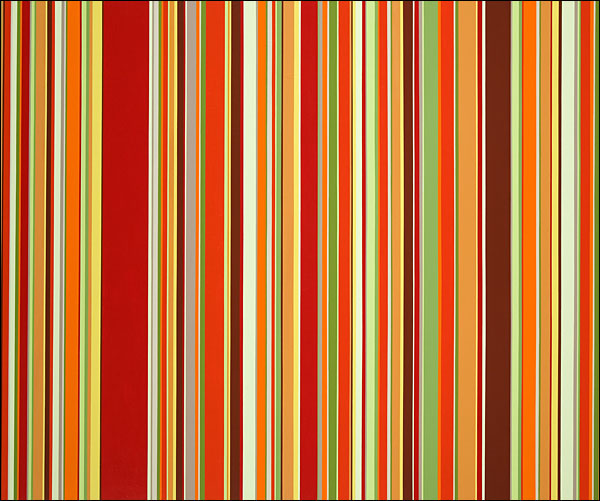
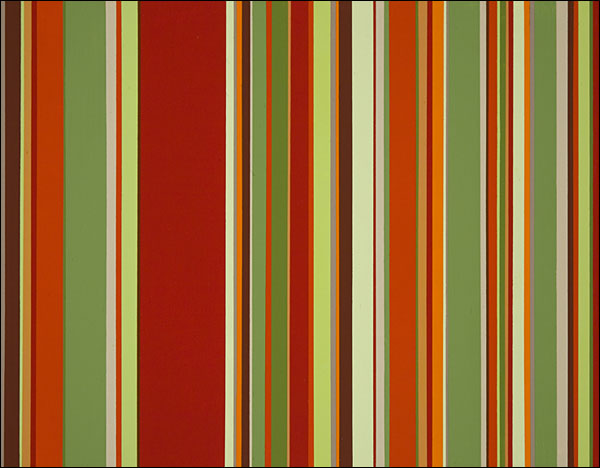
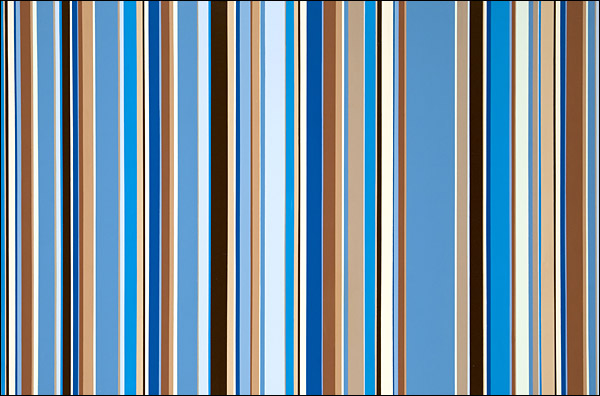
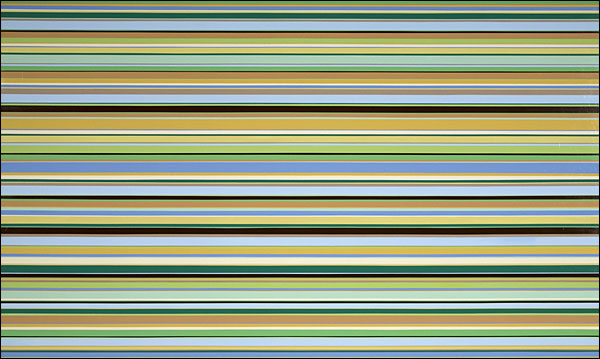
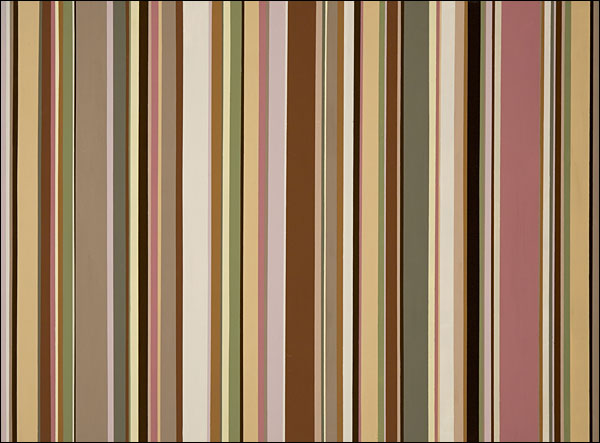
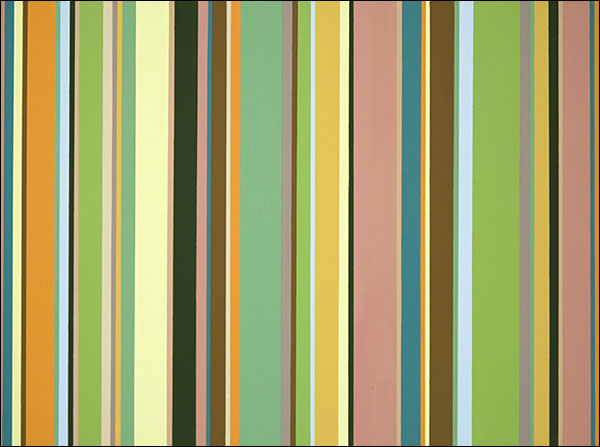
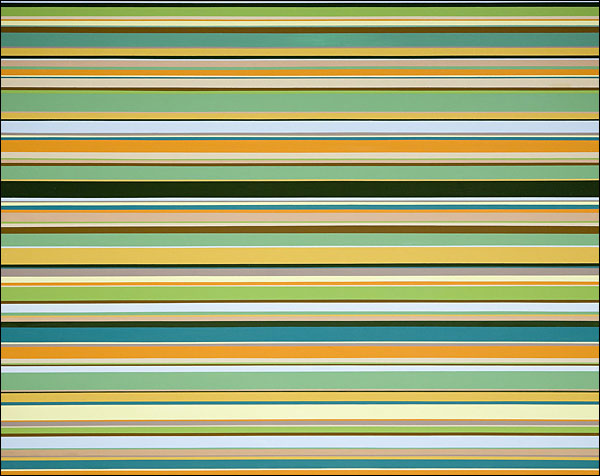
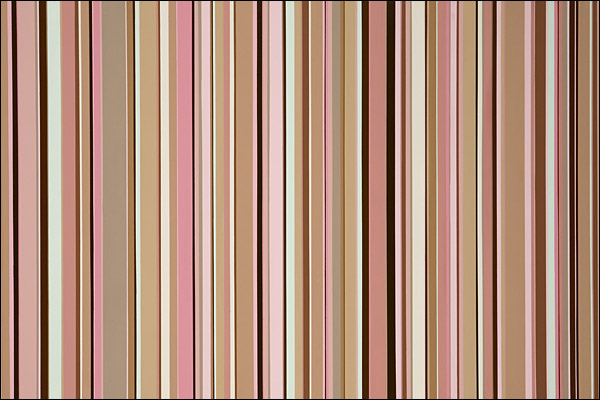
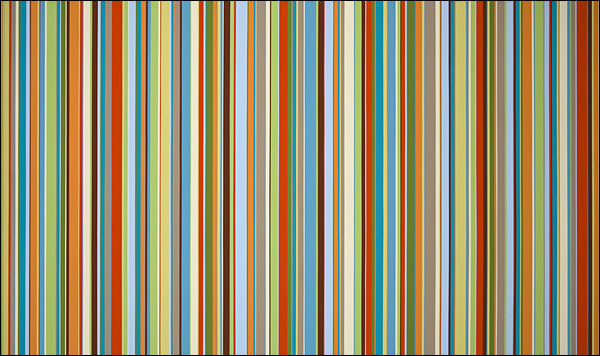
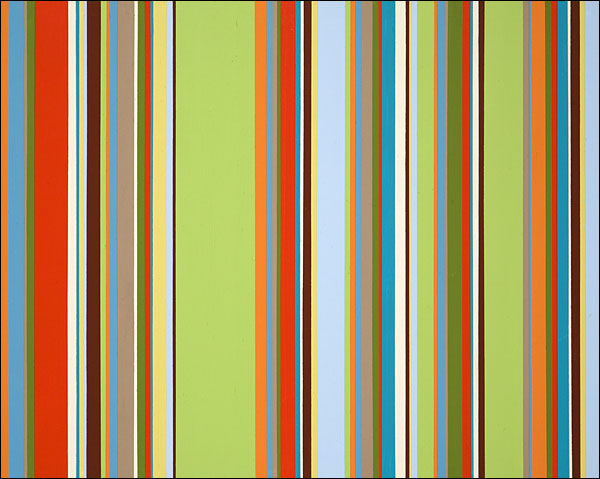
''Betsy Stirratt? Why would an artist like Betsy Stirratt, so skilled in a kind of poetic amorphic painting, so capable of suggestive and evocative mystery, so able to tease out visual interest from the subtlest comminglings of the abstract and the representational, why would she turn her attention to hard-edged vertical and horizontal taped stripe painting? How, one might ask, did she get from there to here, from lissome and dreamy paeans--her Mapping series, for example--that you want to dive into, that endlessly seduce the eye and the mind with the whisper of transport to another time and place, why move from that sylvan land to the severe austerity of parallel stripe painting, to the all-or-nothing brinksmanship of what could be seen as painting's final frontier, the place where the cold logic of determined pictorial fact seems to give you less room to wander, less place to imagine?
Or does it? One of the best things about being an artist must be that one isn't required to answer questions like those posited above, that you just go where you need to go, letting the rest of us catch up as best as we can. Stirratt seems to be offering us here something a bit different, a kind of oblique assault on definition, an abrading of our sometimes too entrenched positions. It's too easy, this work argues, to say that gesture and painterliness are emotional and free while hard-edged linearism is cerebral and closed, that brushstrokes come from the heart while taped edges come from the mind, that to meander is somehow more romantic than to move in straight lines. Stirratt's stripes line up, we discover, not to discipline or close off possibilities, but to open them up, to heighten the drama of you and it, viewer and object, to offer you the there or not there, to invite you to accompany her in how she offers discriminative decisions of the subtlest sort. What stripe, which color, next to what other stripe, what width, tied to what title, why thin/thick, echoing what, why this sequence, is it like the succession of music in time, do they start to quiver and oscillate, do their edges contain them, what rhythm, what dissonance, what push/pull is this, how can this all be so taut and so unruly at the same time?
Sometimes these paintings soothe and sometimes they seethe, sometimes they keep their secrets and sometimes they tell their tales. Stripe paintings--particularly the vertical ones--can start to suggest fences or barriers, closed systems that seem to let you go so far and no farther. They usually seem impassive, aloof, methodical, pursuing crisp procedures that appear to minimize expression and revelation. Stirratt's achievement here is to offer all that tempered by nuance and her long practice of amassing more amorphic color shapes that do her will. She suggests here some meeting of the formal and the personal, of things seen and inventoried (note the suggestiveness of her titles, how they propose some or all of these stripes as rooted in her/our experience of the world, how these abstract parallel elements start to become, well, representational), to bring together the only seemingly irreconcilable zones of thinking and feeling. I haven't been able to shake the impression that in their way Stirratt's paintings are like the keyboard of a piano, an abstract assemblage of stripes ready to be turned into expression of the highest sort, capable in skilled hands of exquisite--and here literal!--coloration and spacing. She plays these bands of color thoughtfully, searchingly, earnestly, with a generosity of spirit that always rings through, offering this avenue too as another platform for the personal, discovering the poignant within the parallel.
- James Yood 2009
(James Yood teaches art history at the School of the Art Institute of Chicago and directs its New Arts Journalism program, and writes regularly for Artforum and Art on Paper magazines.)
Betsy Stirratt was born in New Orleans and received an MFA from Indiana University in 1983. Her work has been exhibited at a number of galleries and museums including the National Museum of Women in the Arts in Washington, White Columns and Artists Space in New York, and the International Museum of Surgical Science in Chicago. She is the recipient of several grants and awards, including a Visual Artist Fellowship from the National Endowment for the Arts. Her work is represented by Packer/Schopf Gallery in Chicago and Ruschman Gallery in Indianapolis.
|